
Gender selection & family balancing IVF in Las Vegas
Gender selection, also known as family balancing, allows patients to choose the sex of the embryo transferred during an IVF cycle. At The Fertility Center of Las Vegas, we use IVF combined with preimplantation genetic testing (PGT) to make this possible — the only method that provides a clinically accurate result.
Why do patients pursue gender selection?
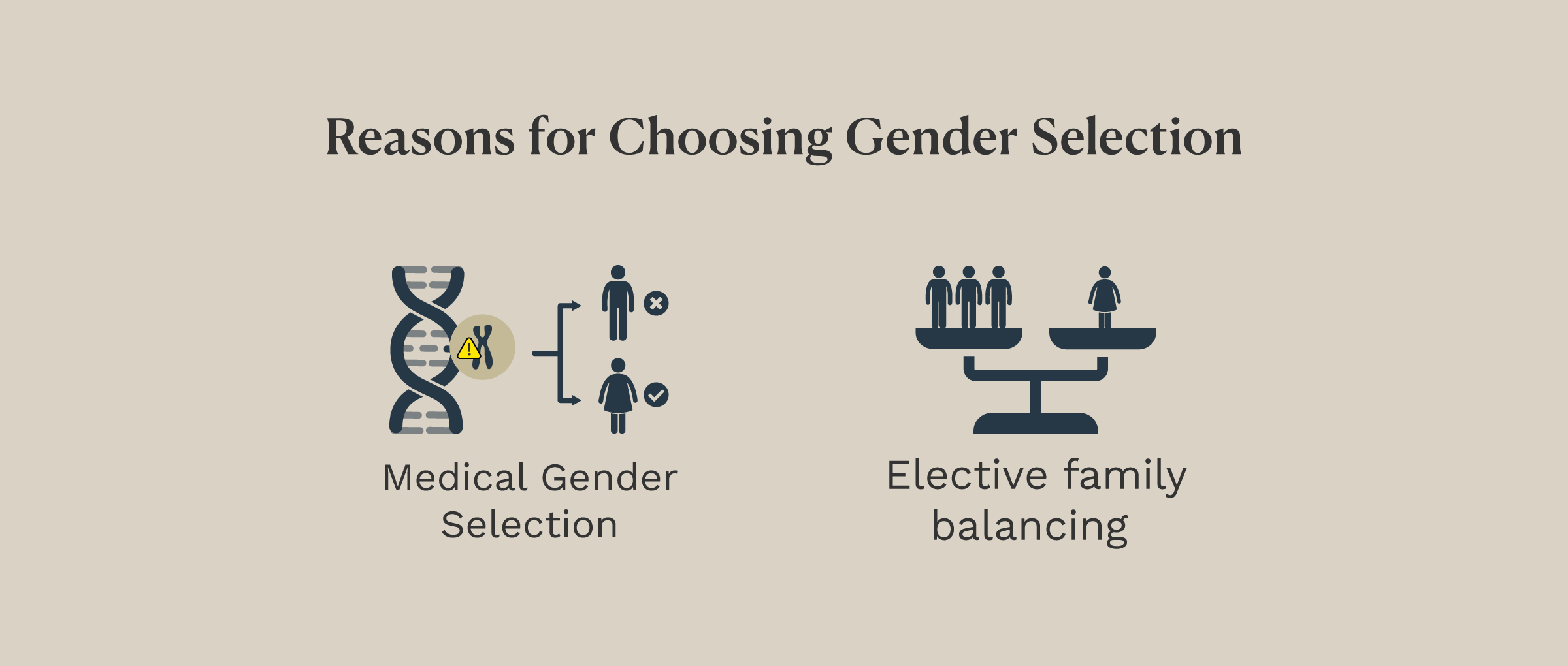
There are two main reasons patients choose gender selection:
- Medical gender selection: some genetic conditions are sex-linked — meaning they primarily or exclusively affect one sex. Muscular dystrophy and hemophilia, for example, are carried through the mother but typically only affect male children. Fragile X syndrome affects one sex more significantly than the other. In these cases, gender selection allows the doctor to transfer only embryos of the less-affected sex, reducing the risk of passing on the condition.
- Elective family balancing: some patients have a preference for a child of a particular sex, often because they already have multiple children of one sex and want to balance their family. Others may have experienced the loss of a child and wish to have another of the same sex. These are deeply personal decisions, and our team approaches them with respect and without judgment.
Gender selection methods: what works and what doesn’t
There are several methods related to gender selection, but not all of them are equally reliable. Patients researching gender selection often come across terms like “sperm sorting” or “gender selection through intrauterine insemination (IUI).” These methods attempt to separate X-chromosome sperm (female) from Y-chromosome sperm (male) before insemination. The scientific support for these approaches is limited, and our doctors do not consider them accurate enough to give patients reliable confidence in the outcome.
At The Fertility Center of Las Vegas, the method we recommend is IVF combined with preimplantation genetic testing (PGT). Rather than attempting to sort sperm before fertilization, this approach allows our embryologists to directly examine the genetic makeup of each embryo after fertilization — giving us a definitive chromosomal result.
The IVF process for gender selection: step by step
Gender selection is performed as part of an in vitro fertilization (IVF). IVF can address a wide range of female and male infertility causes, and is also the path to biological parenthood for same-sex male couples and single men.
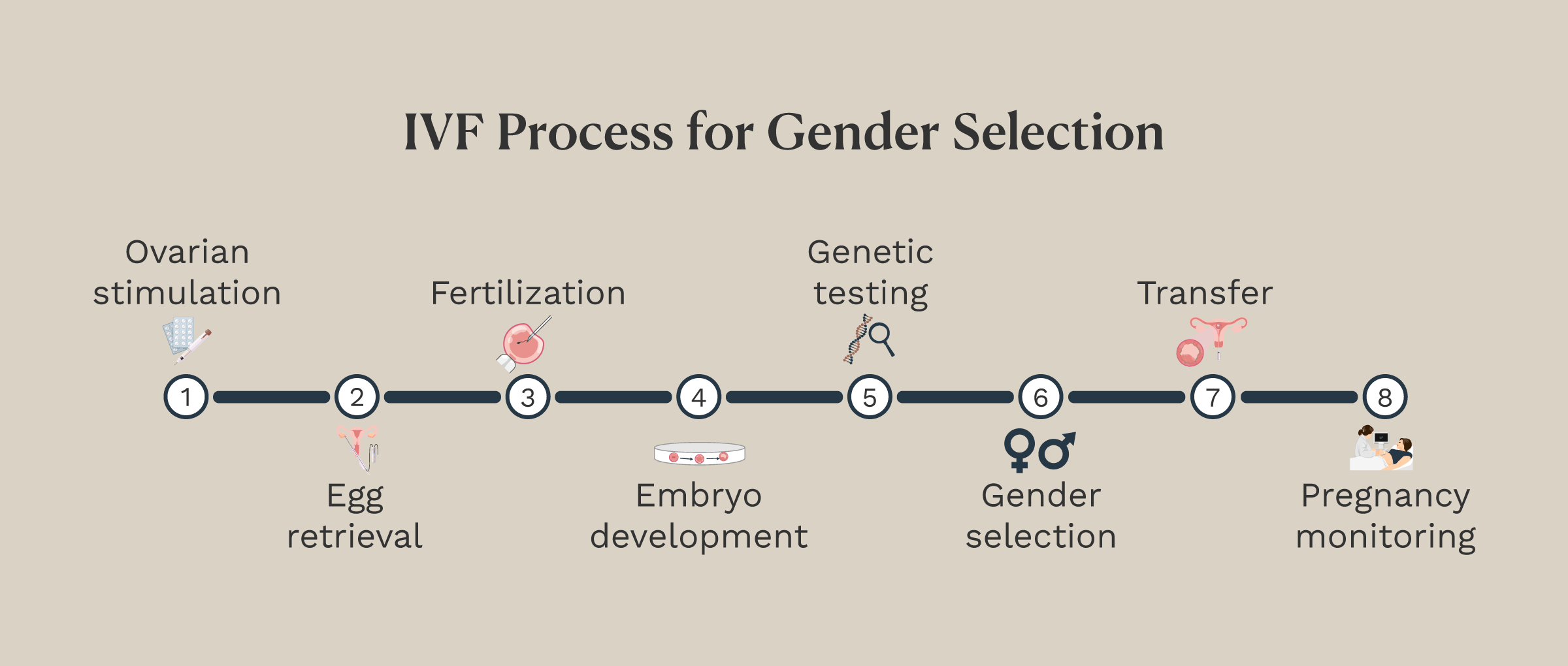
- Ovarian stimulation: the patient providing eggs — either an egg donor or the intended parent — takes injectable fertility medications to stimulate the development of multiple egg-containing follicles. Monitoring appointments every few days allow our team to track progress.
- Egg retrieval: when the eggs are mature, a trigger injection is given to prepare them for release. Approximately 34-36 hours later, the egg retrieval procedure is performed at our Las Vegas clinic. Light sedation is provided, and the procedure is brief and outpatient.
- Fertilization: the retrieved eggs are taken to our IVF laboratory, where an embryologist combines them with sperm from the intended parent or a sperm donor. Fertilization takes place either by placing eggs and sperm together in a culture dish or using intracytoplasmic sperm injection (ICSI).
- Embryo biopsy and genetic testing: between day 5 and day 7 of development, our embryologist takes a small biopsy from the outer layer of each embryo. This layer becomes the placenta, so the biopsy does not harm the embryo itself. The samples undergo PGT-A (chromosomal screening) or PGT-M (single gene disorder testing), which also reveals the chromosomal sex of each embryo.
- Embryo transfer: once results are received, the doctor and patient decide together which embryo to transfer. The goal is to select a chromosomally normal embryo of the desired sex. The embryo transfer is a quick, straightforward procedure — a thin catheter is passed through the cervix into the uterus, and the embryo is gently deposited. It requires no anesthesia.
- Pregnancy monitoring: our team closely monitors the early weeks of pregnancy before coordinating a smooth handoff to the patient’s OB/GYN.
What are the risks of gender selection?
The risks of family balancing are similar to those of a standard IVF cycle. Injectable fertility medications carry a small risk of ovarian hyperstimulation syndrome (OHSS). Close monitoring throughout the stimulation phase at The Fertility Center of Las Vegas allows our team to identify and manage this early, which significantly reduces its occurrence.
The embryo biopsy required for PGT carries a minimal theoretical risk of embryo damage. Because the biopsy samples only the outer layer of the embryo — the cells that form the placenta — this risk is low. Our embryologists are experienced in this technique and take every precaution.
Questions about gender selection? We’re here
If you’d like to learn more about gender selection or family balancing, our team is ready to help. Schedule a consultation at The Fertility Center of Las Vegas.