
Egg freezing in Las Vegas: preserve your future fertility
At The Fertility Center of Las Vegas, we believe that everyone deserves options when it comes to their reproductive future. We proudly offer a range of fertility preservation services, including egg freezing, sperm freezing, and embryo freezing — tailored to each patient’s individual situation and goals.
If you’re considering egg freezing in Las Vegas, our fertility specialists are here to help you understand your options, assess your current fertility, and guide you through every step of the process, so you can pause your biological clock and have a baby when the time is right for you.”
What is egg freezing (oocyte cryopreservation)?
Many patients ask us at their first consultation: “What exactly is egg freezing?” or “What does egg freezing do?” Egg freezing, also known as oocyte cryopreservation, is a fertility preservation procedure that allows you to retrieve and freeze your eggs at their current quality for potential use in the future.
The eggs are preserved using a technique called vitrification — an ultra-rapid freezing process that prevents the formation of ice crystals that could damage the egg’s structure. At the extremely low temperatures of liquid nitrogen storage, all cellular activity stops, keeping the eggs stable for as long as they remain stored.
In simple terms, this process stops the aging of your eggs, keeping them at the exact same quality as the day they were retrieved.
When you’re ready to use them, the eggs are thawed and fertilized through In Vitro Fertilization (IVF). The success of the cycle will depend primarily on egg quality at the time of freezing — which is why freezing at a younger age generally preserves better-quality eggs.
Who is a good candidate for egg freezing?
Egg freezing is appropriate for anyone who wishes to preserve their fertility for the future. The quantity and quality of eggs naturally decrease over time, with this decline accelerating after age 35. Freezing eggs at a younger age generally means preserving higher-quality eggs — though our specialists evaluate each patient individually.
We recommend egg freezing in the following situations:
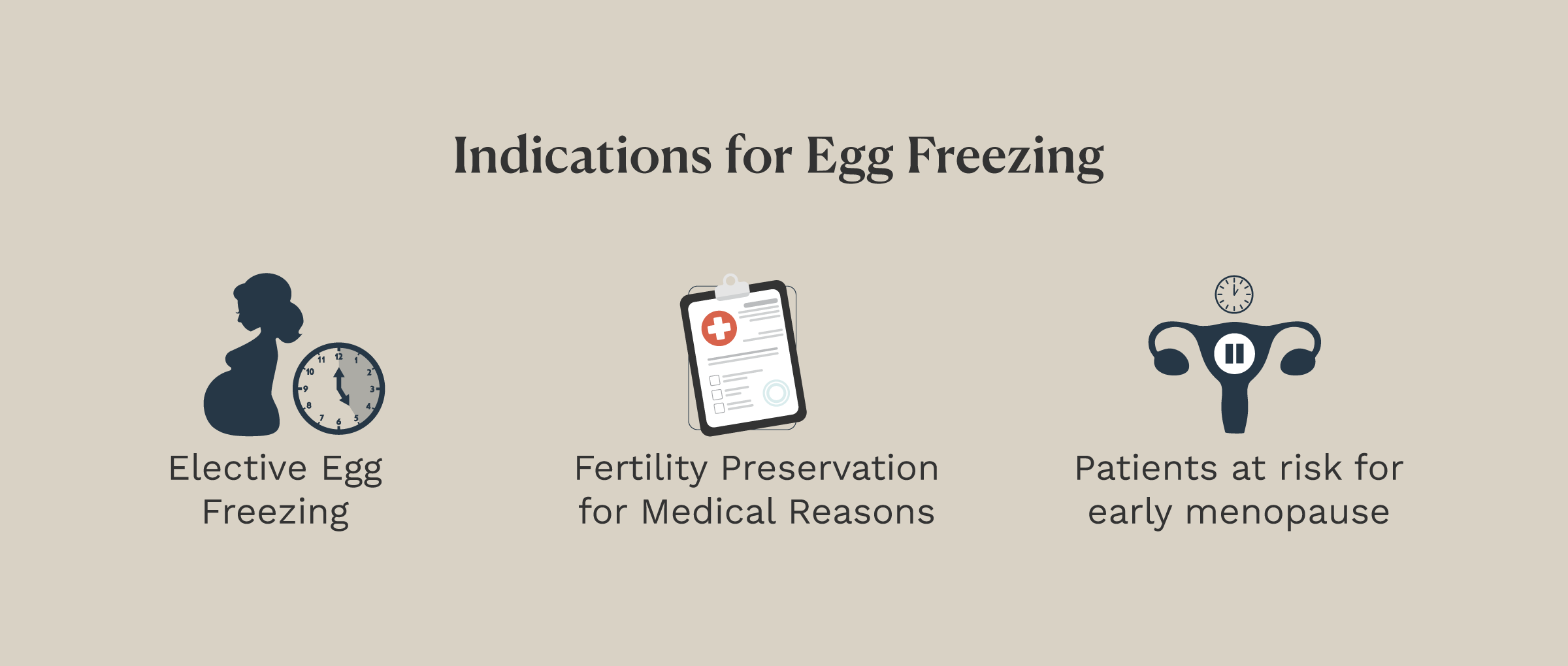
- Elective egg freezing (social freezing): freezing eggs for personal or lifestyle reasons is increasingly common. For many patients, their 20s and 30s are years focused on education, career, travel, or relationships. Egg quality and quantity are typically at their best during this period, making it an ideal time to preserve them.
- Medical fertility preservation: fertility preservation is an important consideration before cancer treatment, including chemotherapy or radiation. It may also be recommended for patients considering egg freezing with endometriosis or egg freezing with PCOS where future ovarian function may be affected.
- Gender-affirming care: for transgender men and non-binary individuals who produce eggs and are beginning or planning hormone therapy or gender-affirming surgery, freezing eggs beforehand preserves the option of biological parenthood in the future.
- Risk of early menopause: if a close family member experienced premature menopause before age 40, you may have a higher risk of the same. Egg freezing before that threshold can protect your reproductive options.
Not sure whether egg freezing is right for you? Contact us to schedule a consultation. Our team will assess your ovarian reserve and help you make an informed decision.
Benefits of egg freezing
Egg freezing offers several meaningful advantages for patients who are not yet ready to start their families or who face medical circumstances that could affect their future fertility:
- Use your own eggs later in life: egg freezing preserves eggs at their current quality. This means patients who delay starting a family can still use their own eggs rather than needing donor eggs.
- Lower genetic risk: because frozen eggs retain the genetic quality they had at the time of freezing, the risk of chromosomal abnormalities is based on your age at freezing rather than your age at transfer — which can meaningfully reduce miscarriage risk for older patients.
- Safe, well-established procedure: while mild side effects from stimulation medications may occur, egg freezing is a well-established, safe procedure. Very rare complications such as Ovarian Hyperstimulation Syndrome (OHSS) are closely monitored for and managed by our team.
- Egg banking: particularly useful for patients with lower ovarian reserve or a poor response to medications, egg banking allows you to accumulate eggs across multiple cycles before proceeding to IVF.
The egg freezing process: step by step
The complete egg freezing process timeline typically takes approximately 10 to 14 days from the start of stimulation to egg retrieval. Here’s what to expect when freezing your eggs:
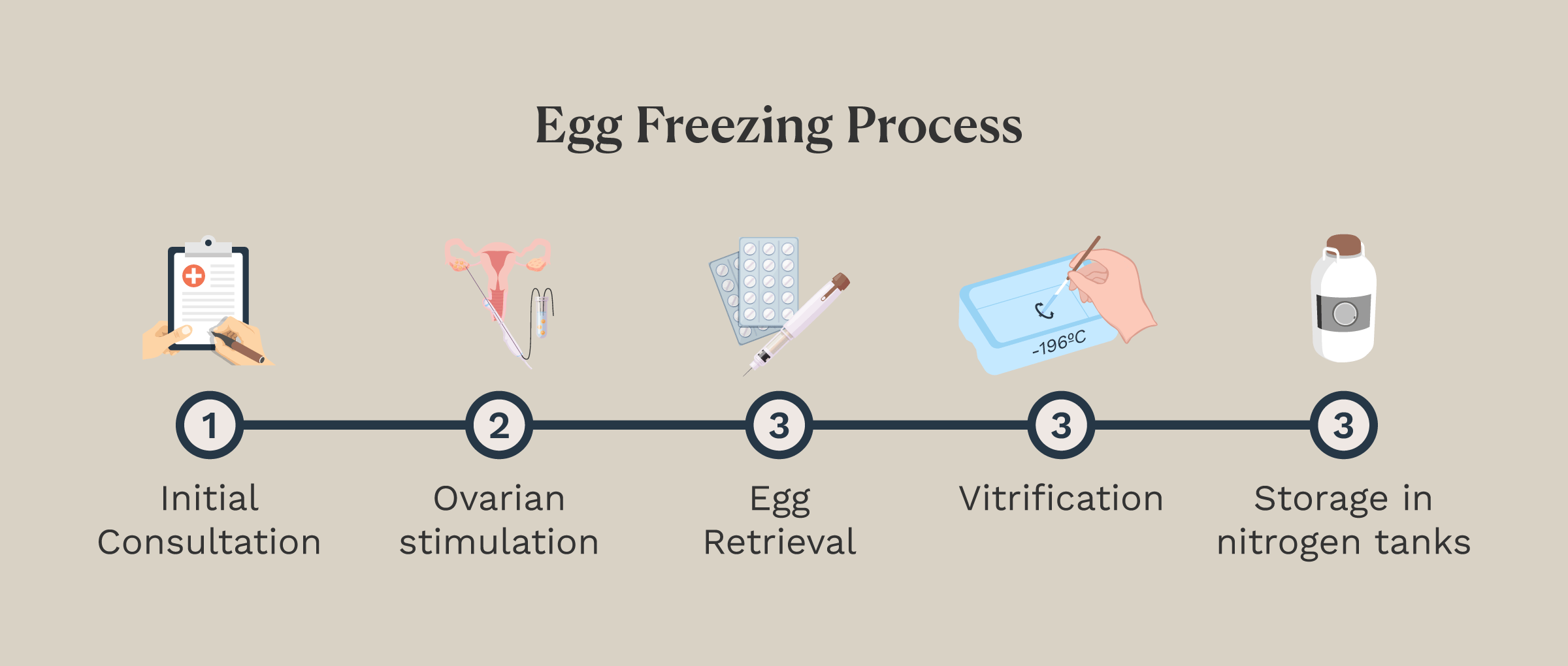
- Initial consultation and fertility testing before egg freezing: the process begins with blood work and a transvaginal ultrasound to perform an antral follicle count (AFC). Based on your ovarian reserve evaluation, your doctor designs a personalized stimulation protocol.
- Ovarian stimulation: for approximately 10 to 12 days, injectable fertility medications stimulate your ovaries to develop multiple follicles. Our team will show you how to self-administer the injections and answer any questions that arise. You’ll come in every few days for monitoring appointments — blood work and ultrasound — to track follicle growth and determine when your eggs are ready. For more detail, read our guide to egg freezing medications.
- Egg retrieval: once your follicles reach the right size, a trigger injection is given to prepare the eggs for release. Approximately 36 hours later, an egg retrieval procedure is performed in our clinic. You’ll receive light sedation so you remain comfortable and unaware during the procedure. Most patients return home the same day.
- Vitrification (flash freezing): immediately after retrieval, our embryologists use vitrification for egg freezing — an ultra-rapid cooling technique using liquid nitrogen. This process prevents ice crystal formation that could damage the egg’s cellular structure, preserving them in their current state.
What happens after retrieval? Long-Term Egg Storage
After the egg retrieval procedure, you can return home the same day to rest. The vitrified eggs are placed in specialized storage tanks at our affiliated facility, Ovation® Fertility Storage Solutions, where they remain until you’re ready to use them. The length of storage does not affect egg viability.
Curious about egg freezing storage costs or how we protect your future? Read our complete guide on long-term egg storage.
Conceiving with your frozen eggs
When you’re ready to use your frozen eggs, our Las Vegas fertility team will coordinate every step of the process. Your eggs are carefully thawed in our laboratory — and because we use vitrification, egg survival rates after thawing are very high.
Once thawed, the eggs are fertilized using Intracytoplasmic Sperm Injection (ICSI) — a technique in which a single healthy sperm is injected directly into each mature egg to support successful fertilization. The resulting embryos are monitored in our laboratory as they develop over the following five to six days.
The highest-quality embryo is then selected and gently transferred into the uterus. Any remaining viable embryos can be frozen and stored for future use.
Ready to learn more? Schedule your consultation
The best time to understand your fertility preservation options is now — before you need them. Schedule a consultation with the specialists at The Fertility Center of Las Vegas and let’s talk through what makes sense for your situation.