
Semen Analysis in Las Vegas: Understanding Your Sperm Test
When a couple is having trouble conceiving, testing both partners from the start is standard practice — and for good reason. Male factors are involved in roughly a third of infertility cases, and contribute alongside female factors in another third. That means in two out of three cases where pregnancy isn’t happening, sperm health is at least part of the picture.
A semen analysis is the starting point for understanding male fertility. It’s non-invasive, straightforward, and gives our Las Vegas fertility specialists a detailed look at what’s actually happening — which is always more useful than guessing.
Semen Analysis Interpretation: Normal values for semen analysis
The test examines both the semen (the thick fluid released during ejaculation) and the sperm cells it contains. Our andrologists at Ovation® Las Vegas, our affiliated laboratory, evaluate each sample against WHO (World Health Organization) reference values. Here’s what they’re looking at:
- Sperm count or concentration: the number of sperm per milliliter of semen. Normal is 16 million/mL or higher.
- Semen volume: the total amount of fluid in the sample. Normal range is 2.0 to 8.0 mL per ejaculation.
- Sperm Motility: the percentage of sperm that are moving. At least 30% should be moving forward.
- Sperm Morphology: the percentage of sperm with a normal shape and structure. At least 4% normal forms is considered adequate.
- Vitality: the percentage of live sperm, including those that aren’t moving.
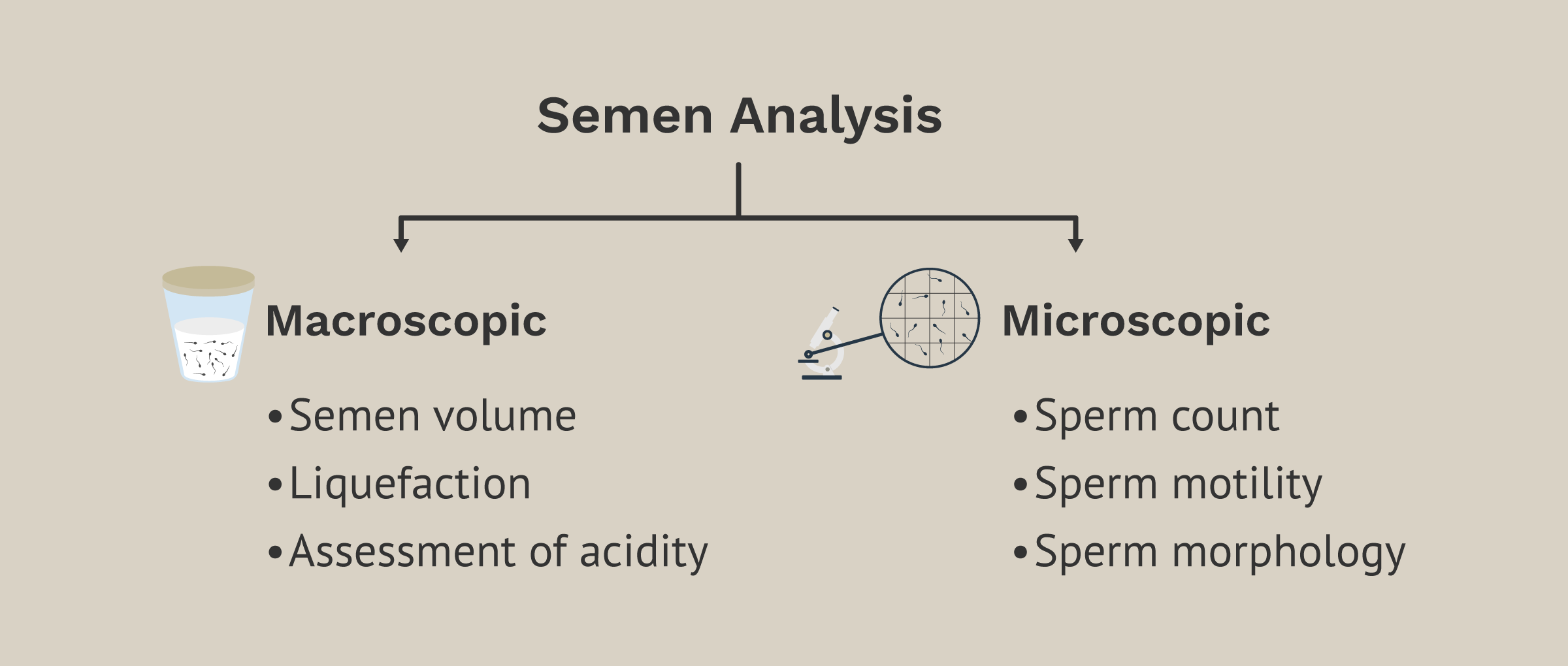
Beyond these core parameters, the analysis also evaluates liquefaction time (how quickly the semen transitions from gel to liquid after ejaculation), pH level (normal range 7.2–8.0), and whether white blood cells are present, which can indicate infection.
One parameter slightly outside the normal range doesn’t necessarily mean there’s a significant problem. Our specialists review results as a whole — one strong parameter can offset a borderline finding in another.
Abnormalities in the semen analysis
If results fall outside normal ranges, your doctor will explain exactly what that means for your situation. Some of the terms you may see on a semen analysis report include:
If results fall outside normal ranges, your doctor will explain exactly what that means for your situation. Some of the terms you may see on a semen analysis report include:
- Oligospermia (Oligozoospermia): low sperm count (below 15 million/mL)
- Asthenospermia (Asthenozoospermia): poor sperm motility (less than 40% moving)
- Teratospermia (Teratozoospermia): abnormal sperm morphology (less than 4% normal forms)
- Hypospermia: low semen volume (less than 2 mL)
- Aspermia (Azoospermia): no sperm present in the ejaculate
Abnormal semen analysis results can also point toward underlying causes that are worth investigating further — hormonal imbalances, infections, blockages, varicoceles (enlarged veins in the scrotum), or immune-related issues. Identifying the underlying cause often opens up additional treatment options.
It’s worth knowing that many men with significantly abnormal semen analysis results go on to have biological children with the right care. The results give us direction, not a verdict.
What happens after a semen analysis?
Once results are in, your doctor will schedule a review consultation to walk through the findings in detail. If everything looks normal, we’ll discuss next steps based on your partner’s results and overall clinical picture. If the analysis identifies any abnormalities, we’ll talk through what they mean and what treatment options make sense.
Depending on the results, next steps might include additional male testing — such as hormone evaluation, sperm DNA fragmentation testing, or a Path SpermQT — or moving toward treatment such as IUI, ITI, or IVF. If a more in-depth evaluation is needed, our doctors work with reproductive urologists for complex cases.
How to prepare for your semen analysis test
Getting the most accurate result depends on following a few simple guidelines in the days before your appointment.
The instructions for the semen analysis collection are as follows:
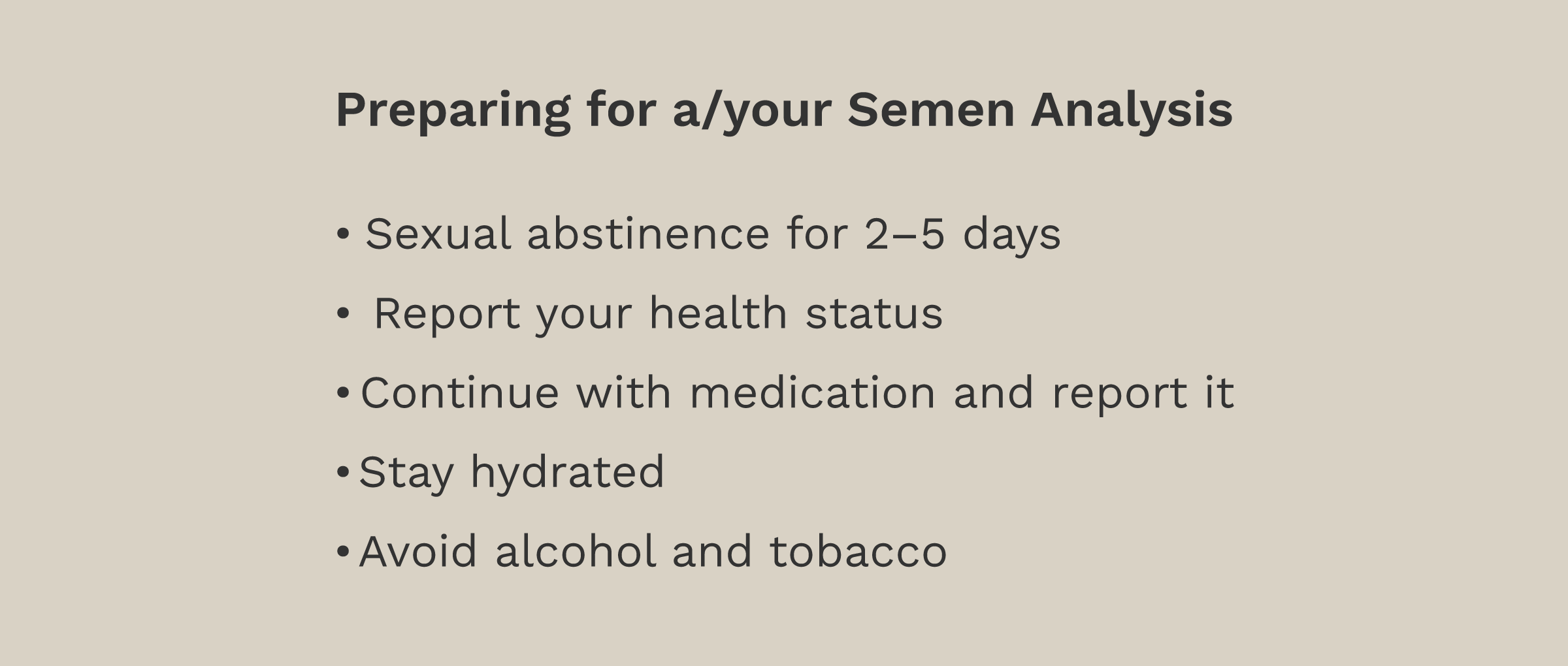
- Abstinence Period: avoid ejaculation for a minimum of 2 days and a maximum of 5 days before your appointment. Going beyond five days can actually reduce sperm quality, so timing matters in both directions.
- Recent illness or fever: let us know if you’ve had a high fever or significant infection in the last 2-3 months. Elevated body temperature can temporarily affect sperm production and may skew results.
- Medications and supplements: continue taking your regular medications, but mention any new treatments or hormone supplements at your appointment.
- Hydration: drink plenty of water in the days leading up to the test.
- Alcohol and tobacco: reduce or avoid both for at least 48 hours beforehand, as they can affect semen parameters.
What to Expect During Semen Collection
Whether you are providing a sample for diagnostic testing or preparing for fertility treatments such as intrauterine insemination (IUI) or in vitro fertilization (IVF), understanding the practical steps helps ensure an accurate result.
You’ll need to collect a semen sample by masturbating into a sterile container — either at our office or at home using a sterile kit provided in advance by our lab team at Ovation® Fertility , provided it reaches the lab within one hour of collection . If collecting at home, the specimen must be kept at body temperature and delivered to our laboratory within one hour of collection at your scheduled drop-off time. The patient must deliver the sample in person — samples cannot be dropped off by a partner or someone else, as we are required to verify the patient’s identity at the time of delivery.
Before your appointment, keep a few requirements in mind:
- Valid Photo ID: To guarantee strict sample tracking and chain-of-custody protocols, patients must present a government-issued photo ID upon delivering the specimen.
- Avoid Lubricants: do not use commercial lubricants, lotions, or saliva. These can affect sperm quality, reduce motility, and skew test results. Ask our staff if you need fertility-safe collection options.
- Sample Processing for Treatment: when collected for IUI or IVF, our lab team washes and isolates the highest-quality, most motile sperm to prepare it for fertilization.
Semen collection carries no physical risks, but providing a sample in a clinical setting can feel stressful or uncomfortable. It is entirely normal to experience anxiety or difficulty. Our team maintains strict discretion and professionalism — if you face any challenges during the process, please let our laboratory staff know so we can discuss alternative options.
Ready to schedule your semen analysis?
A semen analysis is one of the quickest ways to get real answers about your fertility. Contact our Las Vegas clinic to schedule your evaluation — our team will take it from there.