
Female Fertility Testing: What to Expect and What We’re Looking For
If you’ve been trying to conceive without success, fertility testing is the clearest first step toward answers. At The Fertility Center of Las Vegas, our team of reproductive endocrinology and infertility specialists uses advanced diagnostics to understand your egg supply, hormone levels, and the health of your uterus and fallopian tubes — so we can build a personalized plan around you.
Below, we walk you through each test we offer, what it tells us, and how your results will guide your care.
When Should You Get Fertility Testing?
Women are born with all the eggs they will ever have. Over time, both the number of eggs (ovarian reserve) and egg quality naturally decrease — which is why timing matters when it comes to getting a female fertility evaluation.
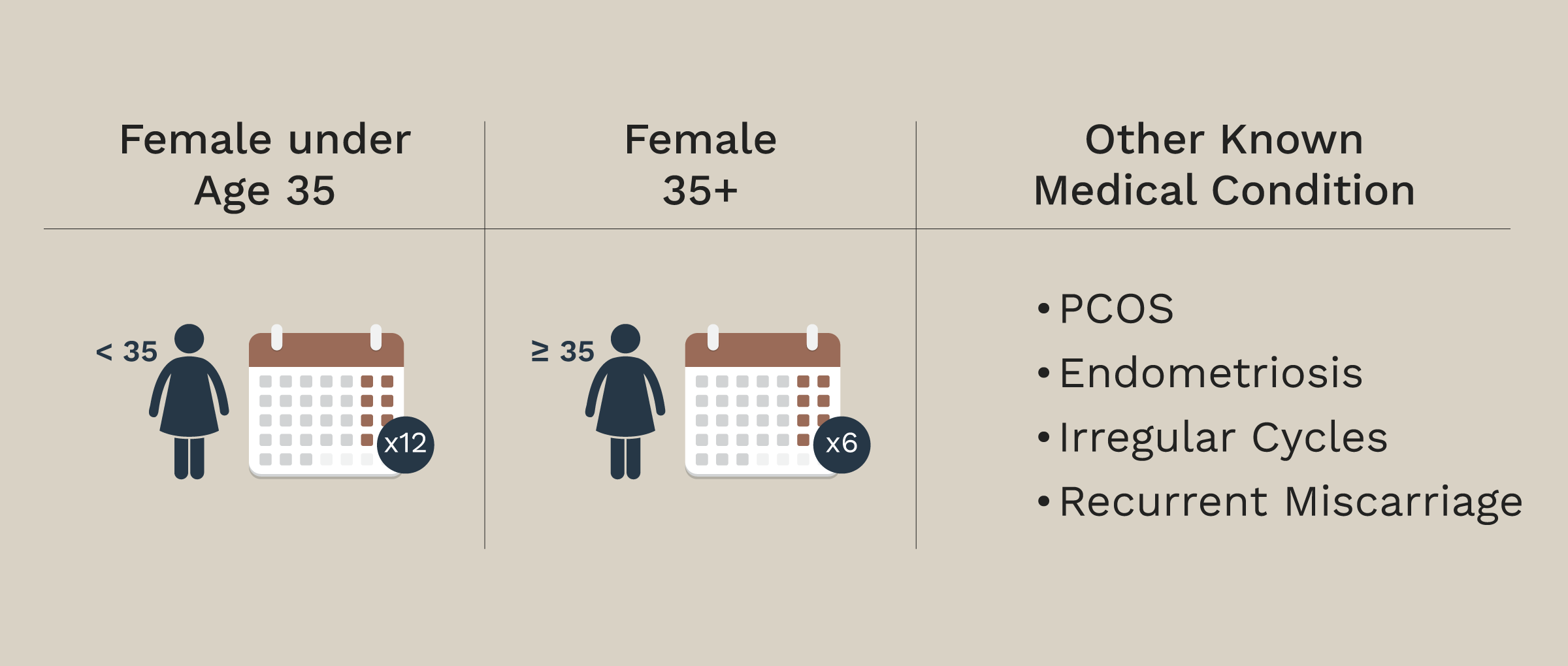
General guidelines recommend scheduling fertility testing based on how long you’ve been trying and your age:
- Under 35: Fertility guidelines recommend seeking testing after 12 months of trying to get pregnant without success. At this stage, egg quality is generally still high, allowing more time and treatment options.
- 35 or older: We recommend coming in after 6 months of trying to conceive without success. After 35, ovarian reserve declines more quickly, and egg quality decreases — which can make conception more difficult and increase the risk of miscarriage. Earlier testing means more options.
If you have any of the following conditions, we encourage you to schedule fertility testing sooner:
- Polycystic Ovary Syndrome (PCOS)
- Endometriosis
- Irregular or absent menstrual cycles
- Recurrent pregnancy loss
- History of reproductive surgery
- A known family history of early menopause or genetic conditions
- Prior chemotherapy or radiation treatment
Knowing where you stand isn’t something to fear — it’s something to use. Understanding your ovarian reserve and reproductive health puts you in a position to make proactive and informed decisions about your future family, whether that’s starting treatment now or preserving your options for later.
Our Female Fertility Diagnostic Panel
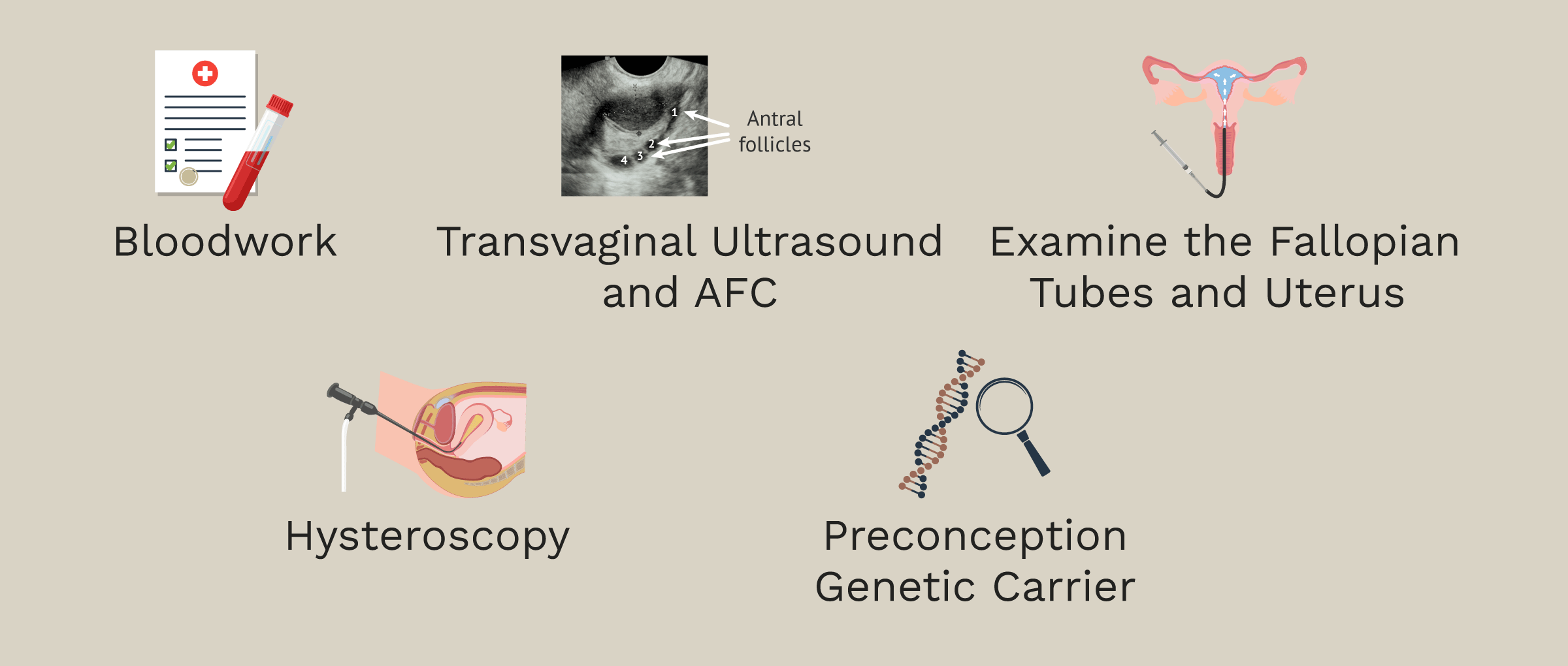
At The Fertility Center of Las Vegas, we design a personalized evaluation tailored to each patient. Our reproductive specialists use a combination of physical exam, blood tests, ultrasound imaging, and structural evaluations to assess your ovarian reserve, ovulation, and reproductive anatomy — giving us the complete picture we need to guide your care.
Physical Examination
As part of your fertility work-up, one of our physicians will perform a physical examination. The exam allows our doctors to identify anything that may need to be addressed alongside your testing, such as thyroid changes, hormonal signs, or other physical findings that could be relevant to your reproductive health.
Transvaginal Ultrasound
Using high-resolution transvaginal ultrasound, our doctors can visualize your pelvic anatomy in real time. This imaging helps to identify certain ovarian conditions, such as cysts, which can impact fertility depending on their type, size, and location.
Ovarian Reserve Testing: AMH, Baseline Hormones and Antral Follicle Count (AFC)
A simple blood draw in our in-house lab gives us a window into your reproductive hormones. The most important marker we look for is Anti-Müllerian Hormone (AMH) — one of the most reliable indicators of your ovarian reserve, providing us with an estimate of how many eggs you have remaining.
We also measure FSH (Follicle-Stimulating Hormone), LH (Luteinizing Hormone), and Estradiol — hormones that show how your brain and ovaries are communicating to regulate your cycle and ovulation. During your transvaginal ultrasound, we also perform an Antral Follicle Count (AFC) — measuring the number of developing follicles (each containing an egg) available during your current cycle. Together with the results of your AFC, these markers give us a detailed hormonal picture of where you are today.
Uterine Evaluation: Sonohysterogram (SHG)
A sonohysterogram (SHG), also called a saline infusion sonogram (SIS), is an in-office ultrasound procedure that uses a small amount of saline solution to give our ultrasound technicians a detailed view of your uterine cavity. It’s minimally invasive, takes only a few minutes, and is well tolerated by most patients.
This allows us to identify abnormalities — such as polyps, fibroids, or a uterine septum — that could affect embryo implantation or your ability to carry a pregnancy, making it an important part of your complete fertility work-up.
Fallopian Tube Evaluation (HyFoSy, HyCoSy, and HSG)
Healthy, open fallopian tubes are essential for natural conception. At The Fertility Center of Las Vegas, we primarily use Hysterosalpingo-Foam Sonography (HyFoSy) or Hysterosalpingo-Contrast Sonography (HyCoSy) — advanced ultrasound tests that evaluate whether the fallopian tubes are open, performed comfortably right in our office.
In some cases, your doctor may recommend an HSG (Hysterosalpingography), an X-ray-based tubal evaluation performed at a radiology center. Your doctor will help determine the best option for you after your initial consultation.
Diagnostic and Operative Hysteroscopy
When we need a direct look inside the uterine cavity, hysteroscopy is the gold standard. Using a small camera passed gently through the cervix, we can directly view and evaluate what’s happening inside — and in many cases, treat what we find in the same procedure.
Hysteroscopy lets us diagnose and address issues like polyps, submucosal fibroids, a uterine septum, or scar tissue (adhesions) — all of which can interfere with embryo implantation if left untreated.
Preconception Genetic Carrier Screening
At The Fertility Center of Las Vegas, we offer advanced genetic carrier screening to help identify the risk of passing on certain inherited conditions. This simple saliva or blood test can determine whether you, your partner, or a donor may carry genes for conditions such as cystic fibrosis or spinal muscular atrophy — allowing you to make informed decisions before starting treatment.
This isn’t about finding problems. It’s about making sure you have complete information before you begin, so your care plan truly reflects what matters most to you.
Ready to Get Answers? Let’s Start Together
Fertility testing is the first step toward clarity — and clarity is the first step toward starting your family. Schedule your fertility testing today and get clear answers about next steps.