
HyFoSy and HyCoSy: Tubal Evaluation in Las Vegas
For pregnancy to occur naturally, the fallopian tubes need to be open — allowing sperm to reach the egg and the fertilized egg to travel to the uterus. Evaluating tubal patency (whether the tubes are open) is a key part of most fertility work-ups.
At The Fertility Center of Las Vegas, our primary approach to tubal evaluation is Hysterosalpingo-Foam Sonography (HyFoSy) — a gentle, in-office ultrasound procedure that uses foam gel to assess whether the fallopian tubes are open, with no X-rays, no iodine dye, and no radiology center visit required. In some cases, we use Hysterosalpingo-Contrast Sonography (HyCoSy), a similar in-office alternative that uses a saline and microbubble contrast solution instead.
Both procedures are well tolerated, radiation-free, and performed entirely in our office — no radiology center visit required.
How do HyFoSy and HyCoSy work?
Both procedures follow the same basic principle: a small amount of contrast material is introduced into the uterus through a thin catheter, and we watch in real time using transvaginal ultrasound to see how it flows.
If the fallopian tubes are open, the contrast material moves freely through them and spills around the ovaries. If a blockage is present, the flow stops. This gives us a clear, immediate answer about tubal patency.
The key difference between the two tests is the contrast material used:
- HyFoSy: uses a foam gel (ExEm foam) that shows up clearly on ultrasound. The foam is gentle, hypoallergenic, and absorbed naturally by the body.
- HyCoSy: uses a saline and microbubble solution. The microbubbles reflect sound waves, making them visible on ultrasound as they travel through the tubes.
In both cases, the procedure is performed entirely in our office. Your doctor will determine which approach is most appropriate for your individual situation.
When is a HyFoSy or HyCoSy recommended?
Your doctor at The Fertility Center of Las Vegas may recommend a HyFoSy or HyCoSy in the following situations:
- You have been trying to conceive for more than 12 months without success (or 6 months if you are 35 or older).
- You have a history of pelvic inflammatory disease (PID) or pelvic surgeries that increase the risk of adhesions or tubal scarring.
- You have a history of endometriosis, which can cause tubal damage.
- You are preparing to begin IUI (Intrauterine Insemination) or ITI (Intratubal Insemination) cycles, where it’s important to confirm at least one tube is open.
If any of these apply to you, our team will review your full history and recommend the most appropriate evaluation for your situation.
HyFoSy, HyCoSy, and HSG: what’s the difference?
Patients often ask how these tests compare. All three evaluate the fallopian tubes — but they differ in method, where they’re performed, and patient experience.
| HyFoSy | HyCoSy | HSG | |
|---|---|---|---|
| Contrast Material | Foam gel (ExEm) | Saline + microbubbles | Iodine-based dye |
| Imaging Method | Ultrasound | Ultrasound | X-ray (fluoroscopy) |
| Radiation | None | None | Yes |
| Iodine Allergy Risk | None | None | Yes |
| Location | FCLV office | FCLV office | Radiology center |
| Uterine Cavity Evaluation | Yes | Yes | Yes |
|
Tubal Patency Evaluation | Yes | Yes | Yes |
For more information on HSG specifically, visit our HSG page.
What are the benefits of HyFoSy and HyCoSy?
Both procedures offer significant advantages over traditional HSG for most patients:
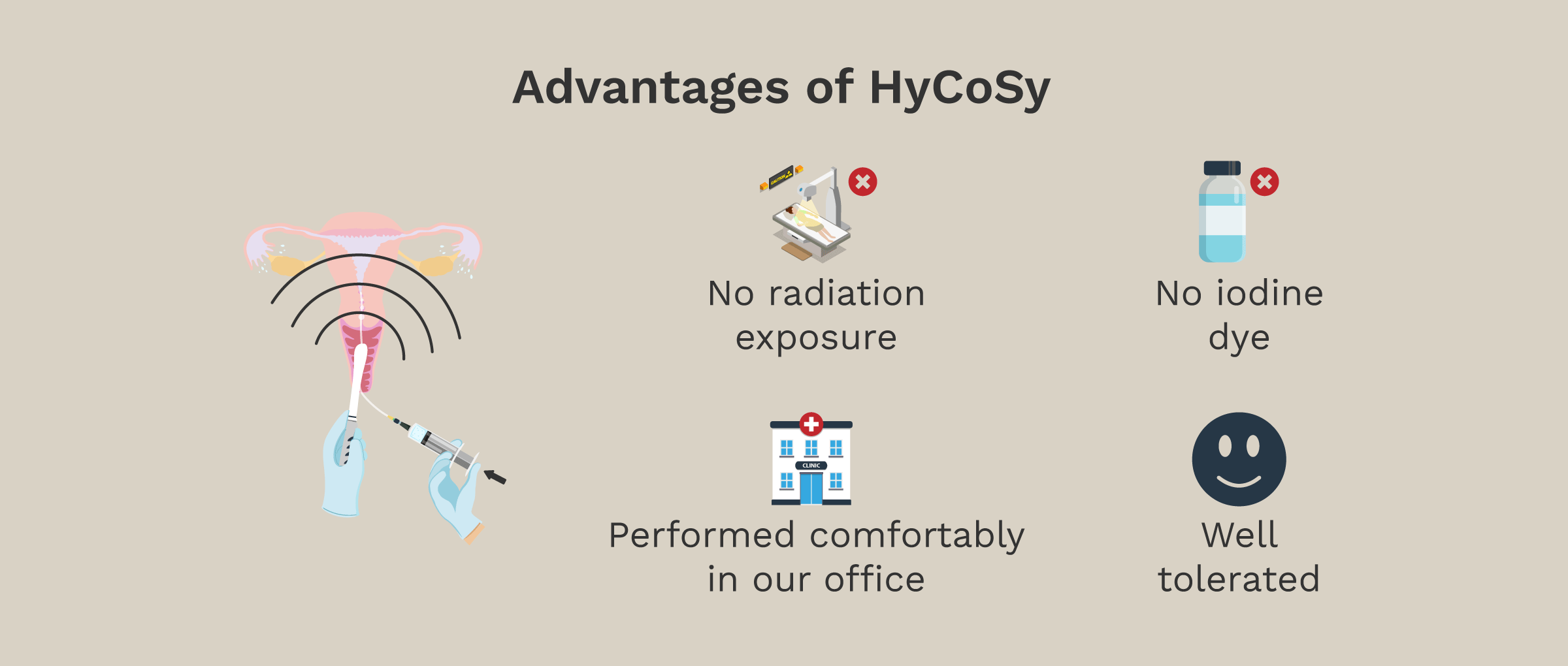
- No radiation exposure: both tests use ultrasound only — no X-rays, no radiological risk to the pelvic tissues or ovaries.
- No iodine dye: neither procedure uses iodine-based contrast, eliminating the risk of allergic reactions associated with HSG.
- Performed comfortably in our office: no referral to a radiology center needed. Your appointment takes place at The Fertility Center of Las Vegas.
- Well tolerated: clinical evidence suggests both procedures cause less discomfort than HSG. Most patients experience mild cramping similar to menstrual cramps.
HyCoSyand HyFoSy Safety: Are there risks or side effects?
HyFoSy and HyCoSy are both extremely safe, minimally invasive procedures with a very low complication rate. The most common side effects are mild and temporary:
- Mild cramping: similar to menstrual cramps, caused by the fluid or foam gently expanding the uterine cavity and tubes. This typically resolves within a few hours.
- Light vaginal spotting: usually resolves within 24 hours.
- Brief dizziness: in rare cases, slight cervical dilation can trigger a mild vasovagal response. This is temporary, and our team will monitor you until you feel fully recovered.
If your clinical history suggests an elevated risk of pelvic infection, your doctor may recommend a short course of prophylactic antibiotics before or after the procedure. This is reviewed on an individual basis.
Questions about your tubal evaluation? We’re here
If you’ve been referred for a HyFoSy or HyCoSy, or you’re just starting your fertility work-up and want to know what to expect, our team is here to walk you through every step. Schedule a consultation at The Fertility Center of Las Vegas and let’s find your answers together.