

Military life runs on orders, and those orders rarely line up with a family-building timeline. For active-duty service members, egg and sperm freezing can offer greater flexibility when planning for future parenthood.
As of September 14, 2026, eligible active-duty service members have a new way to help cover fertility preservation costs. The Defense Health Agency’s Cryopreservation Demonstration Program reimburses many of the costs of freezing eggs or sperm before a qualifying deployment or separation. The pilot runs for three years.
Here’s what the program covers, who qualifies, and how to use it with a civilian fertility clinic like The Fertility Center of Las Vegas (FCLV).
What is the Military Cryopreservation Demonstration Program?
The Cryopreservation Demonstration Program is a three-year pilot that reimburses eligible active duty service members for certain costs of freezing eggs or sperm. The military reimbursement program began September 14, 2026, and is scheduled to end September 14, 2029.
Congress required the program in Section 709 of the Service member Quality of Life Improvement and National Defense Authorization Act for Fiscal Year 2025. The Defense Health Agency (DHA) runs it and will track participation, costs, administrative feasibility, and effects on readiness and retention.
A few points are worth knowing up front:
- Participation is voluntary.
- It’s a reimbursement program. You pay the clinic, then submit for repayment.
- It isn’t a TRICARE benefit, and joining won’t affect your TRICARE eligibility or other military benefits.
- You can use a military hospital with a reproductive medicine program or a civilian fertility clinic. Civilian clinics don’t need to be TRICARE-authorized.
Who qualifies for the Military Fertility Preservation Program?
The program is open to active duty members of the Army, Navy, Marine Corps, Air Force, and Space Force who meet at least one of these conditions:
- You have orders, including deployment orders, for duty that may qualify for hazardous duty pay.
- You’re likely to receive those orders within the next 120 days.
- Under orders, you’ll be geographically separated from a spouse, domestic partner, or dating partner for at least 180 days. Sea duty counts.
Your commander confirms eligibility by signing the reimbursement form (DHA Form 459). You’ll also need an advance medical directive that states what should happen to your stored eggs or sperm if you die. Service members may qualify more than once during the three-year pilot.
The partner definition is broad. Married, partnered, and dating service members all qualify under the separation rule, which matters for LGBTQ+ couples and anyone not yet married.
How much does the military egg and sperm freezing program reimburse?
By law, reimbursement is capped per year:
| Service | Annual Reimbursement Limit |
|---|---|
| Egg freezing | Up to $10,000 |
| Sperm freezing | Up to $500 |
Your one-year window starts on the first date you receive a reimbursable service and runs 365 days. Everything inside that window counts toward the same cap.
Reimbursable services may include:
- Fertility medications
- Lab work and required medical testing
- Imaging, such as ultrasounds
- Egg or sperm retrieval and freezing
- Shipping and storage
The program doesn’t reimburse embryo creation, IVF, or other elective procedures. If your total cost goes above the cap, you’re responsible for the difference. That’s why it helps to get a full written estimate from your clinic before you begin.
When do you need to finish treatment?
The deadlines depend on why you qualify.
- Hazardous duty orders: Testing, retrieval, and freezing must be finished before your orders begin.
- Separation of 180 days or more: You can complete treatment before you leave or during the separation, if care is available where you’re assigned.
- Storage and later shipping: These fees aren’t tied to that cutoff and can be submitted separately later.
Services dated before September 14, 2026, or after September 14, 2029, aren’t reimbursable.
A full cycle includes a consultation and testing, then about 10 to 14 days of stimulation before retrieval. If you have orders in hand or expect them soon, call early. Military hospitals with reproductive medicine programs schedule on a space-available basis and can’t guarantee your timeline, so a civilian clinic may be the faster option.
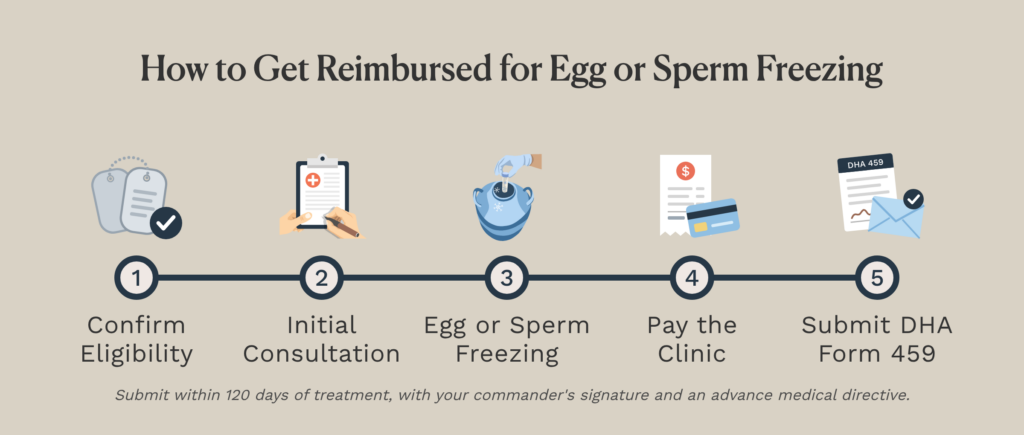
How to apply for military egg or sperm freezing reimbursement?
- Read the eligibility details on the DHA program page.
- Schedule a consultation with your fertility clinic and share your orders timeline.
- Complete your advance medical directive for your stored eggs or sperm.
- Finish testing, stimulation, retrieval, and freezing within your deadline.
- Download DHA Form 459 and have your commander sign it.
- Email the signed form, itemized invoices with all service dates, and proof of payment to the address listed on the DHA program page.
You must submit within 120 days of receiving the services. Remove personal details like your home address and banking information from attachments before you send them. If you don’t get a confirmation email within two business days, follow up.
What does fertility preservation involve?
Egg freezing, also called oocyte cryopreservation, lets you preserve eggs at their current age for possible use later. At FCLV, a cycle generally follows these steps:
- A consultation and testing, including an evaluation of your ovarian reserve.
- About 10 to 14 days of fertility medications to stimulate the ovaries, with bloodwork and ultrasound monitoring along the way.
- An outpatient egg retrieval under sedation.
- Freezing of mature eggs with vitrification, a rapid-freezing method that protects egg quality.
Sperm freezing before deployment, also called sperm cryopreservation, is simpler and is often completed in a single visit. The process generally includes:
- A consultation and any recommended testing.
- Providing a semen sample in a private collection room at our office.
- A laboratory evaluation of sperm count, movement (motility), and shape.
- Freezing the sample in small vials and storing it in liquid nitrogen.
Your physician may recommend more than one sample so there’s enough for future treatment. Because it takes so little time, sperm freezing before deployment is often possible even when orders come with short notice.
Every treatment plan is personalized, and your physician will walk you through your own timeline at your first visit. Sperm freezing is simpler and is often completed in a single visit.
Does the program cover future IVF treatment?
No. The program covers preserving eggs or sperm. It doesn’t cover embryo creation, IVF, or the treatment needed to use your frozen eggs in the future.
When you’re ready to try for a pregnancy, frozen eggs are thawed and fertilized with sperm through IVF, and an embryo is transferred to the uterus. Those future services are billed separately. Some patients choose to freeze embryos instead of eggs, which they can pay for themselves or through other coverage.
Why fertility preservation matters for military families
Freezing eggs or sperm lets you separate two decisions: when to protect your fertility and when to have a child. That flexibility is useful for anyone whose schedule is set by someone else.
Age is the biggest factor in egg quality, so eggs frozen at a younger age generally have a better chance of leading to a pregnancy later. Medical researchers have also noted that military service can affect fertility through injury, environmental exposures, and long separations from a partner.
Fertility preservation gives you options. It can’t guarantee a future pregnancy, and results vary from person to person. A consultation with a reproductive endocrinologist is the best way to understand what freezing could mean for you.
Can I use a civilian fertility clinic in Las Vegas?
Yes. Because the program accepts civilian clinics outside the TRICARE network, service members stationed at Nellis Air Force Base, Creech Air Force Base, or elsewhere in Southern Nevada can complete treatment close to home. Service members based in other states can travel to us, too.
FCLV has cared for patients since 1988 as Southern Nevada’s first fertility clinic. Today we see patients from all 50 states and more than 70 countries. Here’s what that means for service members working against an orders date:
- Board-certified reproductive endocrinologists. Bruce Shapiro, Dr. Carrie Bedient, and Dr. Leah Kaye personally oversee egg and sperm freezing.
- Scheduling around your orders. Tell us your report or departure date when you call, and our team will work backward from it.
- Transparent pricing. You’ll get a written estimate before you start, so you can see how your costs compare with the program’s annual cap.
- Clear documentation. We’ll provide itemized invoices with service dates for your reimbursement submission.
- Support for traveling patients. Our concierge team helps out-of-town patients coordinate visits, monitoring, and travel.
- Care for every family. We welcome single service members, married and unmarried couples, and LGBTQ+ patients.
Frequently asked questions
Does TRICARE cover egg freezing?
This program isn’t part of TRICARE. It’s a separate DoD reimbursement program, and taking part won’t change your TRICARE eligibility. Some service members or their spouses also have civilian insurance with fertility benefits. Our financial team can review your coverage and help you understand your options before you start.
Are National Guard, Reserve, or Coast Guard members eligible?
The program covers active duty members of the Army, Navy, Marine Corps, Air Force, and Space Force. Coast Guard members aren’t listed. Guard and Reserve members should check with DHA about whether their duty status qualifies.
Can a spouse freeze their eggs under this program?
No. Reimbursement is for the eligible service member’s own eggs or sperm.
What if my treatment costs more than the cap?
You’ll pay the remaining balance. Ask for a complete estimate, including medications, before you begin.
How long can my eggs or sperm stay frozen?
Frozen eggs and sperm can be stored for many years. The program can reimburse storage within your annual cap during the pilot, but storage costs after September 14, 2029, aren’t reimbursable.
Talk with our team about your timeline
If you have orders or expect them soon, the earlier you call, the more room you’ll have to finish before your deadline. At your consultation, we’ll evaluate your ovarian reserve and give you a written estimate so you can plan around the program cap.
Request a consultation or call +1 (702) 254-1777, and let us know you’re asking about the military cryopreservation program.
egg freezing, fertility preservation, military, sperm freezing