
Donor Egg IVF in Las Vegas: Building Your Family
For patients who are unable to use their own eggs — whether due to diminished ovarian reserve, early menopause, or certain genetic conditions — donor egg IVF offers one of the highest success rates available in fertility medicine.
At The Fertility Center of Las Vegas, we are internationally recognized experts in advanced third-party reproduction and IVF egg donation. We understand that choosing this path is a deeply meaningful step, and we’re here to support you with world-class care, complete transparency, and our in-house donor program.
Who is a good candidate for donor egg IVF?
Generally, we recommend Donor egg IVF for patients who are unable to use their own eggs, including those with:
- Diminished ovarian reserve: when the number or quality of your own eggs makes successful IVF with your own eggs unlikely.
- Premature ovarian insufficiency (POI) or early menopause: donor eggs allow pregnancy even after natural egg production has declined significantly.
- Certain genetic conditions: where using your own eggs would carry a significant risk of passing on a hereditary condition.
- Advanced maternal age: for patients over 40 — and in some cases into their 50s — donor egg IVF offers significantly higher success rates than IVF with own eggs at that age.
Donor egg IVF is also a primary pathway for single men and same-sex male couples building their families through gestational surrogacy. When needed, donor eggs can be combined with donor sperm to create a fully personalized treatment plan.
Benefits and considerations of donor egg IVF
We believe in being transparent about each treatment option including the pros and cons of donor egg IVF. The most significant benefit is the high probability of success — because donor eggs come from young, healthy donors, genetic risks are lower and implantation rates are higher than with older eggs.
The primary consideration for most patients is the emotional significance of using third-party genetic material. This is a deeply personal aspect of the decision, and it’s entirely normal to have complex feelings about it. Many of our patients find working with a counselor alongside their medical care helpful as they navigate this process. There is also a financial investment involved, which our team will walk you through in detail.
How does the donor egg IVF process work?
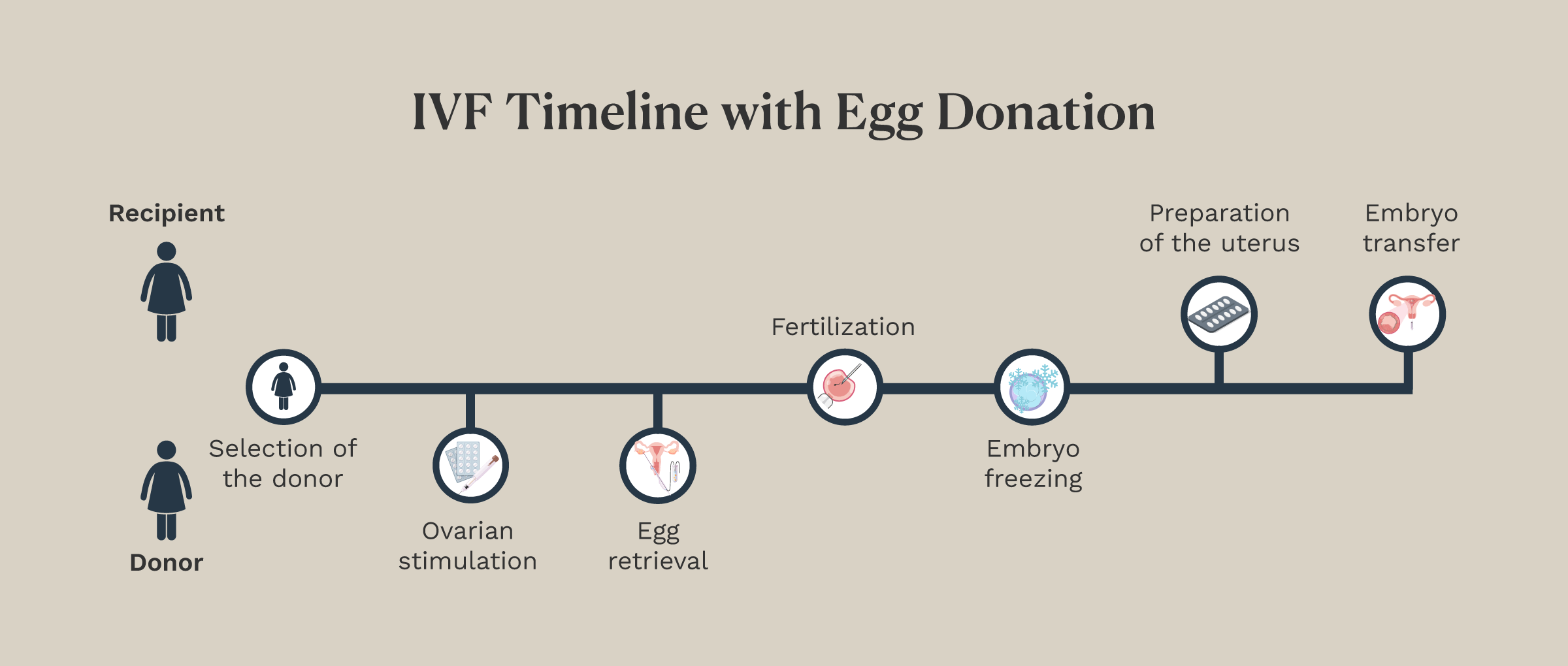
Here is how the step-by-step IVF with donor egg process works at our clinic:
- Egg donor selection: you’ll begin by choosing your egg donor. There are three types of donors: an identified (known) donor (someone known to you personally), and unidentified (also called an anonymous donor), or a semi-identified donor – where some identifying information may be shared or the donor has agreed to future contact. Our in-house donor egg program offers a pool of egg donors who are screened for medical, infectious, genetic and psychological conditions.
- Donor stimulation and egg retrieval: the chosen donor receives medications to stimulate her ovaries to produce multiple eggs, which are then retrieved gently in our clinic.
- Fertilization in the laboratory: our embryologists fertilize the donor eggs with sperm in our IVF laboratory. At this stage, you have the option to include preimplantation genetic testing (PGT) to evaluate the chromosomal health of the embryos.
- Embryo freezing and uterine preparation: the resulting embryos are frozen. The intended parent or gestational carrier takes medication to prepare the uterine lining for transfer.
- Frozen embryo transfer: a single healthy embryo is thawed and transferred into the uterus.
Donor egg IVF success rates
One of the key advantages of donor egg IVF is that success depends primarily on the donor’s age — typically her 20s or early 30s — not on the age of the person receiving the embryo. This means donor egg IVF success rates remain high even for patients over 40 or 45.
According to the latest national data from the Society for Assisted Reproductive Technology (SART):
- Recipients under 40: approximately 50–55% chance of a live birth per cycle.
- Recipients ages 40–44: success rates remain very similar, with only a minimal decrease compared to younger recipients.
- Recipients 45 and older: although there is some decrease, success rates are still significantly higher than IVF with own eggs at the same age.
These are national averages and do not reflect individual results. During your consultation, our specialists will review your specific history and provide personalized expectations for your situation.
Have questions about donor egg IVF? We’re here
If you’re considering donor egg IVF or would like to learn more about your options, our team is ready to help. Schedule a consultation at The Fertility Center of Las Vegas and let’s take the next step together.