

Understanding your menstrual cycle is one of the most useful things you can do for your reproductive health — whether you’re actively trying to conceive or just want to know what’s normal for your body.
It’s completely normal for cycles to vary by 3-4 days from month to month. But when periods become genuinely unpredictable — showing up weeks late, skipping entirely, or fluctuating wildly in length — there’s usually a reason worth understanding.
At The Fertility Center of Las Vegas, we see irregular cycles as a signal, not just an inconvenience. Most of the time there’s an identifiable cause, and most of those causes respond well to treatment. Here’s what we most commonly find.
Symptoms of an irregular menstrual cycle
Clinically, a regular menstrual cycle lasts between 21 and 35 days — counted from the first day of one period to the first day of the next. It should also be reasonably consistent month to month.
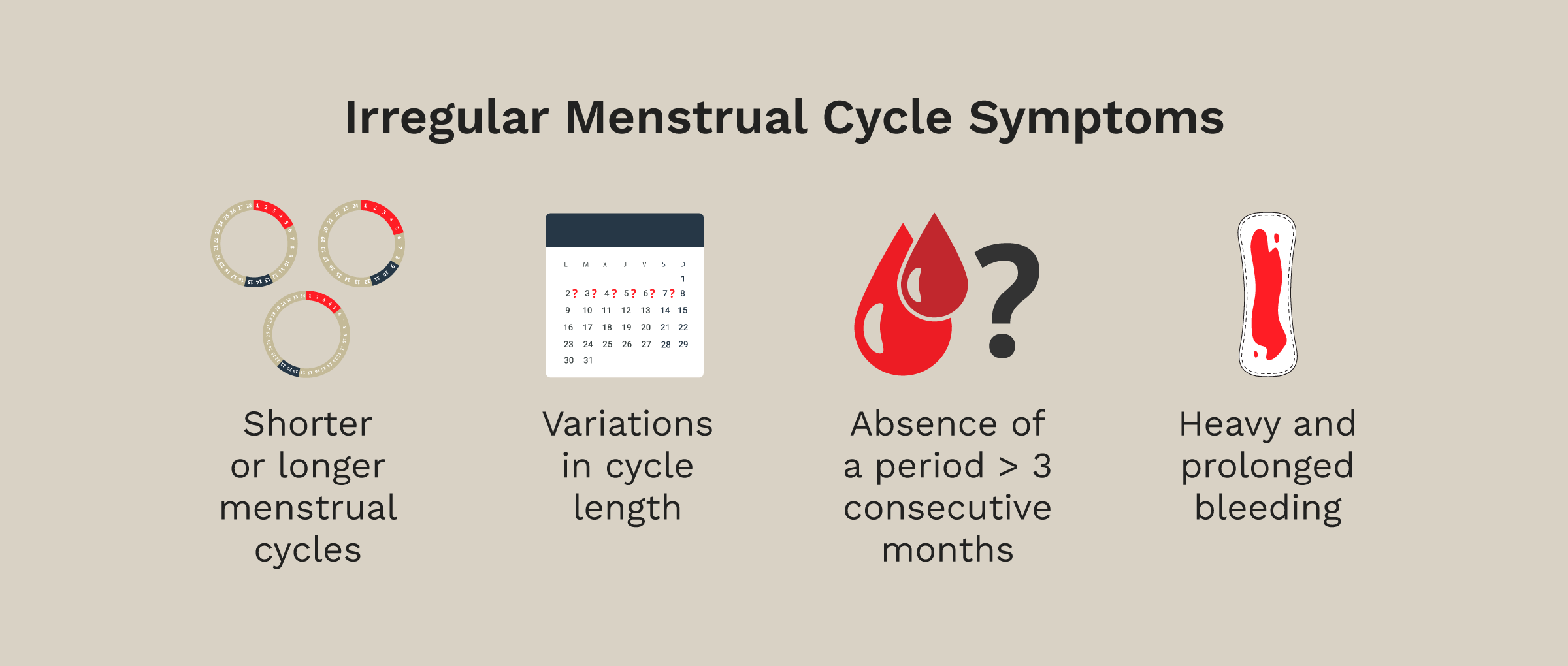
You’re considered to have an irregular menstrual cycle if any of the following apply:
- Your cycles are consistently shorter than 21 days or longer than 35 days
- The cycle length varies greatly from month to month (e.g. 24 days one month, 42 the next)
- You’ve missed your period for three or more consecutive months (amenorrhea)
- Your periods are unusually heavy or last significantly longer than 7 days
Beyond cycle length, irregular menstrual cycle symptoms like spotting between periods, unusually painful cramps, bloating, or fatigue around the expected time of your period are worth mentioning to your doctor — particularly if they’re new or worsening.
What causes irregular periods?
Irregular periods almost always come down to a hormonal disruption that interferes with ovulation. Without predictable ovulation, the hormonal signals that trigger a period don’t fire on schedule — and cycles go off-rhythm as a result.
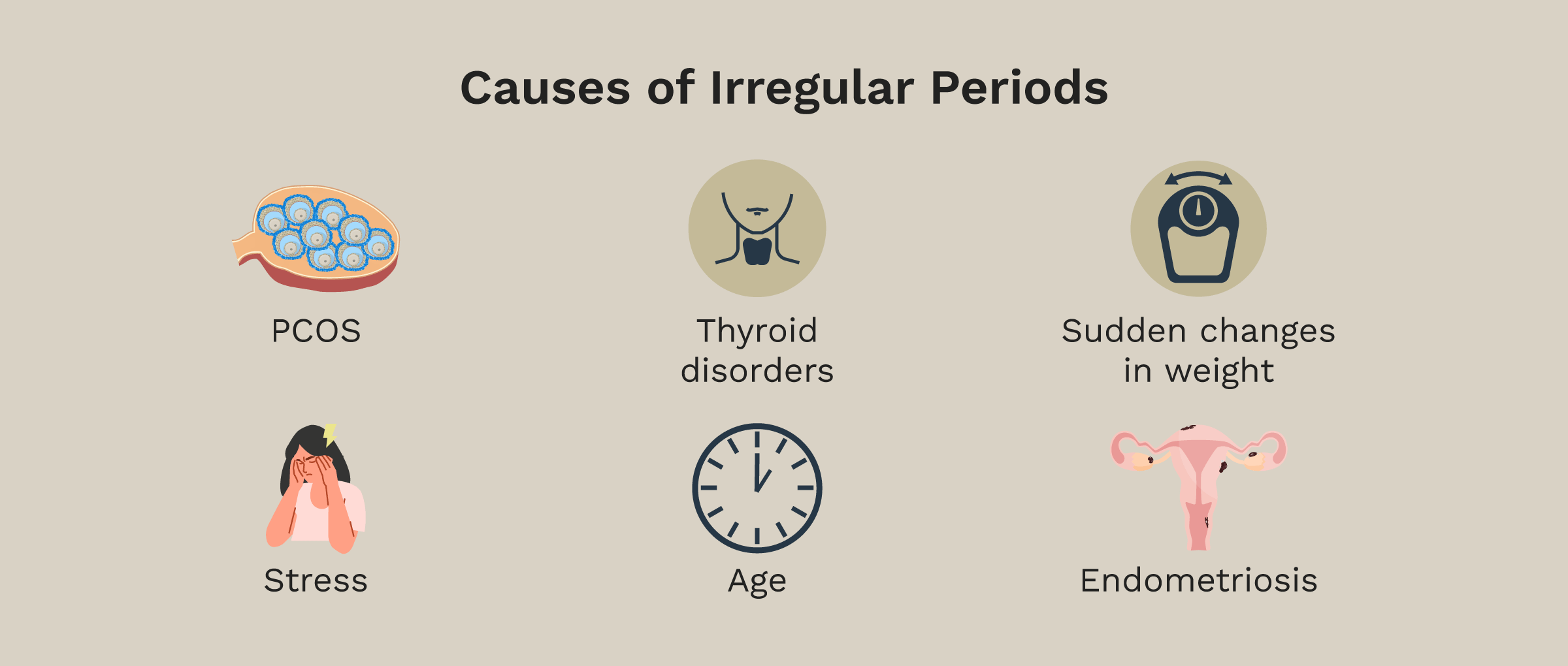
Here are the most common underlying causes of irregular periods:
1. Polyendocrine Metabolic Ovarian Syndrome (PCOS/PMOS)
PMOS (previously referred to as PCOS) is the most common hormonal cause of irregular periods. It’s a condition in which the ovaries produce higher-than-normal levels of androgens (male hormones), which interferes with the development and release of eggs. This often results in long gaps between periods, missed cycles, and small cysts on the ovaries.
Irregular ovulation is the central fertility challenge with PMOS, but it responds well to treatment. Other signs you might notice alongside cycle irregularity include persistent acne, unwanted facial hair, or difficulty managing weight.
2. Thyroid disorders
The thyroid gland controls metabolism and plays a direct role in regulating reproductive hormones. Both an underactive thyroid (hypothyroidism) and an overactive thyroid (hyperthyroidism) can disrupt your cycle — causing periods that are irregular, very heavy, or absent altogether.
Thyroid disorders are detected with a simple blood test and generally respond well to medication. When thyroid levels stabilize, menstrual regularity usually follows.
3. Significant weight changes or extreme exercise
The reproductive system is sensitive to physical stress. A very low body mass index, rapid weight loss, or intense exercise can signal to the body that conditions aren’t safe for reproduction — and ovulation gets suppressed as a result. On the other side, significant weight gain can raise estrogen levels in ways that disrupt the cycle as well.
Addressing the underlying physical factor — whether that means restoring a healthy weight or moderating exercise intensity — often brings the cycle back into a normal rhythm on its own.
4. Chronic stress
Severe physical or emotional stress increases your levels of cortisol, the “stress hormone.” Stress can cause irregular menstrual cycles in women by keeping cortisol levels high for a prolonged period, which interferes with the hypothalamus. This is the part of the brain that regulates the hormones controlling your menstrual cycle. If you have gone through a major stressful event, you may notice your cycle becomes temporarily irregular.
5. Endometriosis
While endometriosis is most commonly associated with painful periods, it can also cause irregular bleeding patterns — including spotting between periods or cycles that are unpredictably heavy or prolonged. Endometriosis is often underdiagnosed, and cycle irregularity alongside significant pelvic pain is worth investigating.
6. Age and ovarian reserve
As the body approaches menopause, declining egg quality and quantity naturally make cycles less predictable. Perimenopause — the transition phase before menopause — typically begins between ages 40 and 50 and often brings irregular cycles as one of its first signs.
However, if cycle irregularity begins before age 40, it could indicate Premature Ovarian Insufficiency (POI) or diminished ovarian reserve. Either warrants a prompt evaluation with a fertility specialist, since both can affect your ability to conceive and your options for doing so.
How does an irregular menstrual cycle affect your fertility?
Irregular cycles don’t make pregnancy impossible — but they do make it more difficult. For conception to happen, sperm and egg need to meet at the right time. When ovulation is unpredictable or absent, that timing becomes very hard to hit.
This is also why over-the-counter ovulation predictor kits are less reliable for patients with irregular cycles. These kits detect a hormone surge that happens before ovulation — but if your hormones are imbalanced, the results can be confusing, inaccurate, or simply miss the window entirely. Medical cycle monitoring at our clinic gives a much more accurate picture.
When should you seek help from a fertility specialist?
We recommend scheduling a fertility evaluation if any of the following apply:
- You’re under 35, have been trying to conceive for 12 months, and have irregular cycles
- You’re 35 or older and have been trying for 6 months
- You haven’t had a period in over three months and aren’t pregnant
- You have a known condition like PCOS/PMOS or a thyroid disorder
- Your periods are heavy enough to interfere with your daily life
One thing worth knowing: regular periods don’t guarantee fertility. It’s entirely possible to have predictable cycles and still struggle to conceive due to tubal blockages, ovarian reserve issues, or male factor infertility. If you’ve been trying for a year (or six months if you’re over 35) with regular cycles and no success, a fertility evaluation is still the right next step.
Have questions about your cycle? We’re here to help
If your cycles are irregular and you’re trying to conceive — or just want to understand what’s behind the irregularity — we’re here to help. Schedule a consultation at The Fertility Center of Las Vegas and let’s find out what your cycle is telling us