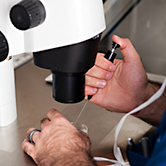
The Fertility Center of Las Vegas keeps abreast of the current best practices in fertility medicine, and continually improves the state of the art to deliver patients results. Both Drs. Shapiro and Daneshmand work diligently to elucidate better, more cost-effective methods of helping men and women experiencing infertility have a family. We are proud of the extensive research we've lead and the positive impact it has made in reproductive medicine.

The Leading Edge

IVF Research at The Fertility Center of Las Vegas

At the Fertility Center of Las Vegas, our philosophy is to stimulate optimally, trigger safely, and transfer your best embryos into an ideally prepared uterus.  While these principles may seem obvious, extensive research was needed to determine how to achieve these goals.  We continue to improve the best practices of fertility medicine.

We were among the first to standardize blastocyst transfer in the late 1990s.  This practice allows us to select the most viable embryos for transfer. Growing embryos to the blastocyst stage before transfer prevents the transfer of embryos that lack the developmental potential to reach the blastocyst stage. This cannot always be recognized from an embryo’s appearance at earlier stages. With blastocyst transfer, we select the most viable embryos.   This way we can sustain high pregnancy rates while transferring fewer embryos, and therefore reducing the risk of triplet pregnancy.

Our recent publications on blastocyst transfer:

Large blastocyst diameter, early blastulation, and low pre-ovulatory serum progesterone are dominant predictors of clinical pregnancy in fresh autologous cycles.
Bruce S. Shapiro, Said T. Daneshmand, Forest C. Garner, Martha Aguirre, Shyni Thomas. Fertility and Sterility.  In Press.

Contrasting patterns in in vitro fertilization pregnancy rates among fresh autologous, fresh oocyte donor, and cryopreserved cycles with the use of day 5 or day 6 blastocysts may reflect differences in embryo-endometrium synchrony.
Shapiro BS, Daneshmand ST, Garner FC, Aguirre M, Ross R.
Fertility & Sterility. 2008.

Blastocyst diameter, day of blastulation, and pre-ovulatory serum progesterone simultaneously correlate with clinical pregnancy after blastocyst transfer.
Shapiro, B.S.; Daneshmand, S.T.; Garner, F.C.; Aguirre, M.; and Thomas, S. 23rd Annual Meeting of the European Society of Human Reproduction and Embryology, Lyon, France, 2007.

Comparing Day 5 and Day 6 Blastocyst Transfers in Fresh Autologous, Frozen Autologous, and Fresh Oocyte Donor Cycles
B. S. Shapiro, S. T. Daneshmand, F. C. Garner, M. Aguirre, R. Ross.
06-A-434-ASRM

Granulocyte-macrophage colony-stimulating factor enhances human embryo development to the blastocyst stage: a randomized study
Shapiro BS, Richter KS, Daneshmand ST, Quinn P, Behr B
Fertility and Sterility- 2003 04 (Vol. 79, Issue (Supplement 2))

Vero cell coculture with sequential blastocyst media: a randomized controlled study comparing two different cleavage-stage media formulations
Shapiro BS, Richter KS, Harris DC, Daneshmand ST
Fertility and Sterility- 2002 04 (Vol. 77, Issue (Supplement 3))

Quantitative grading of a human blastocyst: optimal inner cell mass size and shape.
Richter KS, Harris DC, Daneshmand ST, Shapiro BS.
Fertility and Sterility. 2001 Dec;76(6):1157-67.

A comparison of day 5 and day 6 blastocyst transfers.
Shapiro BS, Richter KS, Harris DC, Daneshmand ST.
Fertility and Sterility. 2001 Jun;75(6):1126-30. 

Predictive value of 72-hour blastomere cell number on blastocyst development and success of subsequent transfer based on the degree of blastocyst development.
Shapiro BS, Harris DC, Richter KS. Fertility and Sterility. 2000 Mar;73(3):582-6. 


Patient safety is paramount.  One of the greatest risks for IVF patients, particularly those with high response to ovarian stimulation, is that they may acquire “ovarian hyperstimulation syndrome” (OHSS).  The severe form of OHSS is serious, and should be avoided whenever possible. 

A hormone called hCG is implicated in the cascade of events leading to OHSS.  Many clinics use only hCG to trigger ovulation in IVF patients.  Often they are forced to cancel cycles in very high responding patients in order to avoid OHSS.  Or they might “coast” (stop the stimulation early), a practice shown to reduce egg yield.  Still, the incidence of OHSS remains too high.

We were among the first to standardize the use of GnRH agonist for final oocyte maturation in very high responders.  We use the GnRH agonist alone or with a very small dose of hCG.  This practice safely gives high yields of high-quality eggs while virtually eliminating the risk of significant OHSS. There is no need to cancel or “coast” cycles in our patients with high response.

Our recent publications on safe triggering to eliminate OHSS:

Gonadotropin releasing hormone agonist combined with a reduced dose of human chorionic gonadotropin for final oocyte maturation in fresh autologous cycles of in vitro fertilization.
Bruce S. Shapiro, M.D., Said T. Daneshmand, M.D., Forest C. Garner, M.S., Martha Aguirre, Ph.D., and Shyni Thomas, B.S. Fertility and Sterility In Press.

Comparison of human chorionic gonadotropin and gonadotropin-releasing hormone agonist for final oocyte maturation in oocyte donor cycles.
Shapiro BS, Daneshmand ST, Garner FC, Aguirre M, Ross R. Fertility and Sterility July, 2007 (Vol. 88, Issue 1, 237-9).

Cumulative pregnancy rates when using GnRH agonist instead of hCG for final oocyte maturation 
S. T. Daneshmand, B. S. Shapiro, F. C. Garner, M. Aguirre, R. Ross.
06-A-1468-ASRM

Eliminating Severe Ovarian Hyperstimulation Syndrome By Using GnRH Agonist Instead of HCG
Shapiro BS, Daneshmand ST, Garner FC, Aguirre M, Ross R
Fertility and Sterility- 2005 04 (Vol. 83, Issue 5 (Supplement))

Effects of the ovulatory serum concentration of human chorionic gonadotropin on the incidence of ovarian hyperstimulation syndrome and success rates for in vitro fertilization.
Shapiro BS, Daneshmand ST, Garner FC, Aguirre M, Ross R, Morris S.
Fertility and Sterility 2005 Jul;84(1):93-8.

Low serum HCG concentrations following the ovulatory dose of HCG are not associated with reduced IVF success rates
Shapiro BS, Daneshmand ST, Garner FC, Aguirre M, Ross R, Morris S. 
Fertility and Sterility- 2004 04 (Vol. 81, Issue (Supplement 3))

Comparison of human chorionic gonadotropin and gonadotropin-releasing hormone agonist for final oocyte maturation in oocyte donor cycles.
Shapiro BS, Daneshmand ST, Garner FC, Aguirre M, Ross R. Fertil Steril. 2007 Jul;88(1):237-9.

Including a low dose of hCG along with GnRH agonist “trigger” reduces early pregnancy loss rates when compared to the agonist alone. 
BS Shapiro, ST Daneshmand, FC Garner, M Aguirre, S Thomas. Accepted for: 63rd Annual Meeting of the American Society for Reproductive Medicine, Washington D.C. October, 2007.

We were among the first to employ blastocyst freezing and thawing.  Our technique yields excellent embryo survival rates and high implantation and pregnancy rates, allowing us to give our patients more flexibility.   For example, a high implantation rate with frozen embryos makes it more practical to transfer only one embryo at a time, for those seeking only singleton pregnancies.  Our effectiveness with frozen embryos allows many patients to achieve pregnancy without needing to go through additional ovarian stimulation cycles if the fresh cycle should fail, or if they want to have additional children after a successful cycle.

Our recent publications on the transfer of frozen blastocysts

Improved Survival and Pregnancy Rates with Transfer of Cryopreserved Blastocysts
S. T. Daneshmand, B. S. Shapiro, F. C. Garner, M. Aguirre, R. Ross.
06-A-406-ASRM

Improved Survival and Implantation Rates for Thawed Embryos
Aguirre M, Shapiro BS, Daneshmand ST, Garner FC, Ross R
Fertility and Sterility- 2005 04 (Vol. 83, Issue 5 (Supplement))

Cumulative IVF Pregnancy Rates After Fresh and Frozen Embryo Transfer

Daneshmand ST, Shapiro BS, Garner FC, Aguirre M, Ross R
Fertility and Sterility- 2005 04 (Vol. 83, Issue 5 (Supplement))


Main Menu Directory for The Fertility Center of Las Vegas, NV   The Fertility Center of Las Vegas, NV List of Services and Definitions regarding Reproductive Services   The Fertility Center of Las Vegas, NV Research Department and Articles   Financial Information on how to finance in-vitro fertilitization and other reproductive services by the Fertility Center of Las Vegas, NV   The Fertility Center of Las Vegas, NV Background Information and Reputation